 4 hours ago
744
4 hours ago
744

The cryptocurrency market has had a rollercoaster run in 2025, with most assets hitting record highs before the current pullback.
In this environment, portfolio selection becomes critical, as choosing the right assets is key to maximizing returns while managing the sector’s inherent volatility.
Looking ahead to 2026, Finbold asked OpenAI’s ChatGPT to construct a $1,000 crypto portfolio designed to balance liquidity, infrastructure exposure, and differentiated growth opportunities, while deliberately avoiding the most crowded trades.
Below is the model’s selection and allocations.
Bitcoin and Ethereum
The portfolio is anchored by Bitcoin (BTC) with a $250 allocation. While its weighting is lower than in many traditional crypto portfolios, ChatGPT noted that Bitcoin remains foundational as the market’s primary liquidity hub, supported by institutional adoption, its store-of-value role, and its tendency to lead market cycles.
Ethereum (ETH) follows with a $200 allocation. Despite rising competition, ChatGPT argued that Ethereum remains the dominant settlement layer for decentralized finance, tokenized real-world assets, and enterprise blockchain use cases.
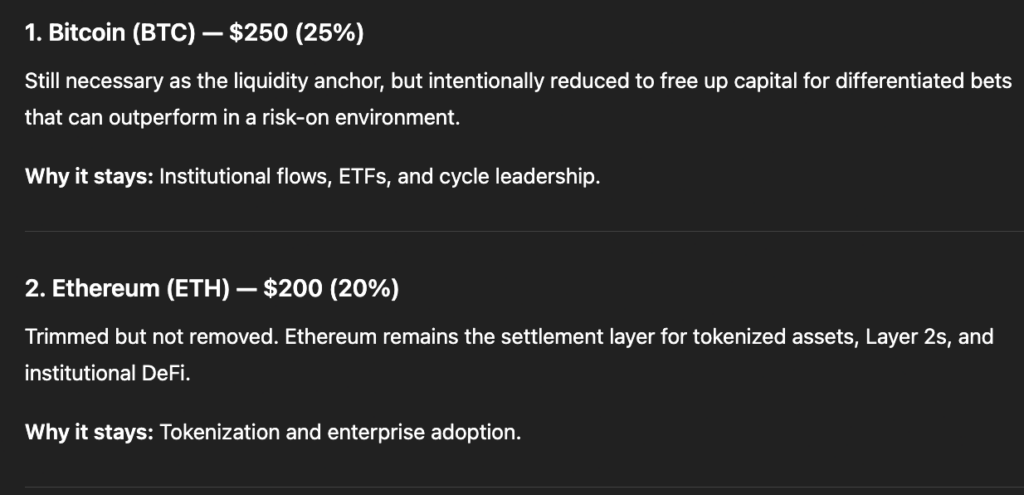 Bitcoin and Ethereum alocation for 2026. Source: ChatGPT
Tokenization and infrastructure
Beyond Bitcoin and Ethereum, the portfolio emphasized tokenization and infrastructure. Ondo Finance received $120 as exposure to bringing traditional assets such as U.S. Treasuries on-chain, reflecting demand for compliant, yield-bearing products. Chainlink (LINK) was also allocated $120, positioned to benefit from tokenization and cross-chain activity through its leading oracle and messaging services.
The portfolio also included emerging blockchain architectures. In this line, ChatGPT selected Celestia (TIA), with a $100 allocation, representing a bet on modular blockchain design that separates data availability from execution and consensus, potentially improving scalability and lowering barriers for developers if the modular thesis gains traction.
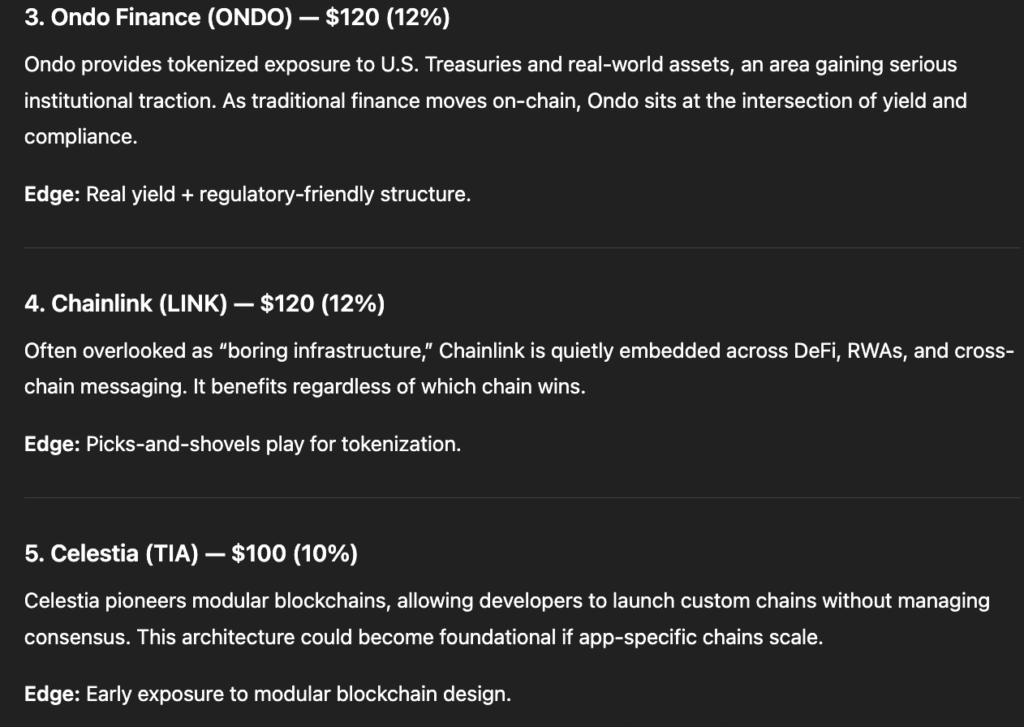 Tokenization and infrastructure crypto alocation for 2026. Source: ChatGPT
Computing and artificial intelligence
In the high-performance computing and artificial intelligence segment, Render (RNDR) received $80. The project focuses on decentralized GPU rendering, aligning blockchain incentives with growing demand for compute power from AI, 3D graphics, and immersive digital environments.
Kaspa (KAS) is allocated $70 as a technically differentiated proof-of-work network using a blockDAG architecture. By prioritizing fast confirmations and high throughput while retaining proof-of-work security, it offers an alternative scaling model outside the dominant Bitcoin and Ethereum frameworks.
Rounding out the portfolio is Arbitrum (ARB) with a $60 allocation, positioned to benefit from Ethereum’s growth by capturing activity and fees as users migrate to Layer 2 networks for lower costs and higher throughput.
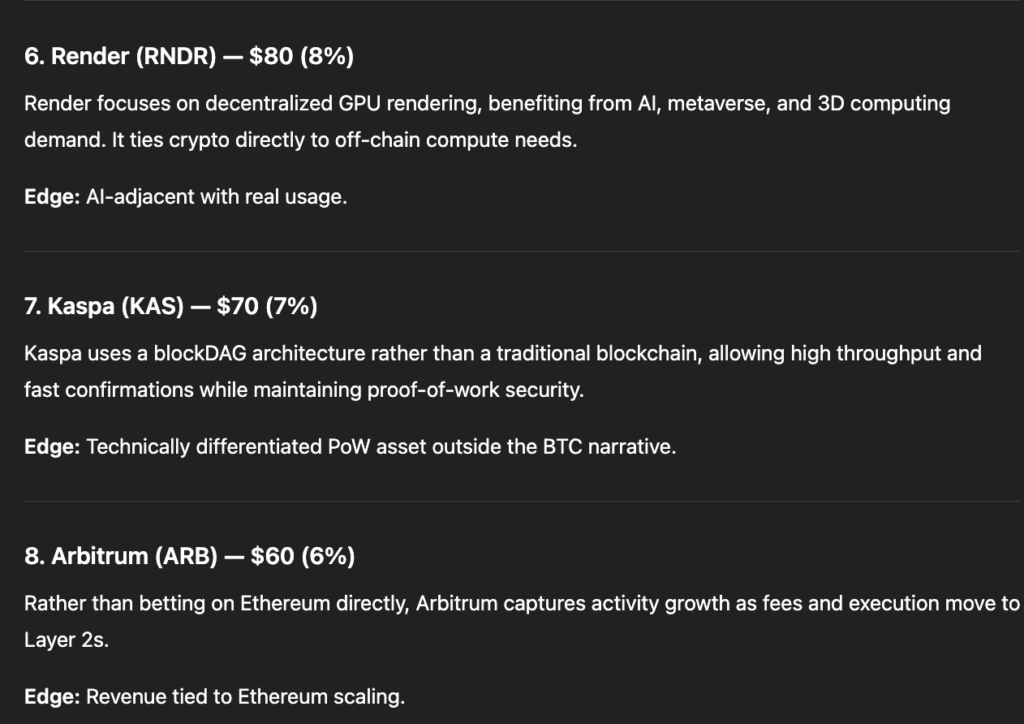 Computing and AI crypto alocation for 2026. Source: ChatGPT
Overall, the $1,000 portfolio allocates less than half to Bitcoin and Ethereum, with the remainder focused on infrastructure, tokenization, scalability, and compute-driven use cases.
ChatGPT argued this reflects an expectation that the next phase of crypto growth will favor projects tied to real economic activity and technical utility rather than purely narrative-driven momentum.
Featured image via Shutterstock
The post ChatGPT builds a $1,000 crypto portfolio for 2026 appeared first on Finbold.





 English (US)