
 3 hours ago
511
3 hours ago
511

Amid renewed United States attacks on Iran, a cryptocurrency trader has netted notable profits from betting that Washington would strike Tehran.
In this case, a trader identified as Vivaldi007 on the betting platform Polymarket earned about $385,000 by anticipating the military action, according to the latest on-chain data retrieved on February 28.
Insights show the trader, who joined Polymarket on February 8, 2026, began placing wagers on the likelihood of U.S. and Israeli strikes against Iranian targets.
Despite early setbacks from unsuccessful bets on various potential attack dates, the situation shifted following a coordinated U.S.-Israeli operation on February 28, 2026, targeting key Iranian facilities amid ongoing disputes over nuclear enrichment and regional influence.
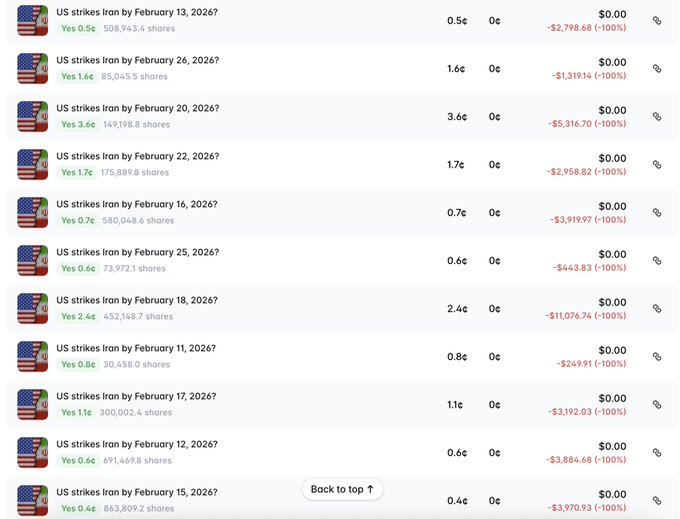 Crypto trader’s bet on U.S. strikes in Iran. Source: Polymarket
 Vivaldi007 spread investments across multiple February contracts, predicting strikes by specific dates, reflecting a firm belief in imminent escalation. Early bets expired worthless, but the confirmed strike validated several positions, pushing total profits to about $385,000 by February 28.
More strikes expected
Meanwhile, another trader, using the wallet Roeyha2026, opened an account just 11 hours earlier and wagered roughly $50,000 that the U.S. would strike Iran by March 1, 2026.
The position quickly swelled to about $96,800 in profit, prompting speculation over whether the trade was coincidental or informed by advance knowledge.
The gains come amid growing scrutiny of potential insider activity on Polymarket. Past cases of well-timed geopolitical bets have attracted attention from regulators and analysts, with some resulting in criminal charges tied to the misuse of sensitive information.
While no evidence links the latest trades to insider activity, the pattern of newly created or narrowly focused accounts posting outsized returns has renewed debate over market integrity and oversight in decentralized prediction markets.
Impact of financial markets
Meanwhile, the attack has had significant ramifications on the broader financial market. For instance, oil prices jumped on fears of supply disruptions through key routes such as the Strait of Hormuz, lifting Brent crude more than 3% to around $72.76 per barrel. Gold climbed toward $5,200 per ounce as investors sought safety.
Cryptocurrencies moved the other way as Bitcoin fell sharply, triggering over $100 million in liquidations, while short sellers benefited as digital assets were treated as risk-sensitive.
Featured image via Shutterstock
The post Crypto trader nets $380,000 from U.S. strike on Iran appeared first on Finbold.









 English (US)