
 2 hours ago
5089
2 hours ago
5089

Bitcoin’s recent price action has started to wear on people. After a strong start to the year and a run that pushed above $100,000 and briefly touched $125,000, the market has drifted into something closer to a low-volatility grind. On the 1000x podcast, ProCap’s Jeff Park argued that this shift in “market structure” is not a minor detail. In his view, it is the central reason Bitcoin has struggled to reassert momentum, even as gold and other commodities have pushed to fresh highs.
Bitcoin Needs Volatility
Park’s thesis is straightforward: Bitcoin’s upside story historically leans on volatility. If volatility compresses and stays compressed, Bitcoin loses one of the features that has consistently attracted marginal risk capital, especially the kind of capital that shows up early, pushes price, and then pulls in the next cohort behind it.
“There’s two things we need to hit on,” Park said. “One is the belief in the projection that I have for Bitcoin to reach meaningfully new highs that we need implied volatility and realized volatility to rise concurrently. And then the second is to your question, why is that not happening today?”
He framed Bitcoin less as an isolated “crypto asset” and more as one instrument in a much wider relative-value universe. In that universe, Bitcoin competes for allocation with equities, rates, FX, and commodities, not just other tokens. And the attribute that made Bitcoin distinct for many allocators was its capacity for asymmetric outcomes, which volatility helps express.
“Bitcoin is not in a microcosm of its own, right?” Park said. “You’re competing with Mag 7, you’re competing with gold, you’re competing with FX, you’re competing with JGBs, and it’s a huge world out there. And the feature that I think Bitcoin has always been exciting for a lot of folks is to capitalize upon asymmetric outcomes in which the volatility is one of the unique features that makes it worthwhile for the risk-taking endeavor.”
Bitcoin Needs ‘Real’ Buyers
That sets up the uncomfortable comparison the hosts kept circling: gold making new highs while Bitcoin lags. Park didn’t try to wave it away. He called it a moment for Bitcoin holders to be realistic about adoption and about where the truly structural bids are right now.
“The reality is gold is going up because there’s real buyers, right?” he said. “There’s real buyers stepping in as there has been for the past year and a half. And those structural bids continue to exist because it has found a product market fit within our global monetary framework as a reserve asset.”
Park argued Bitcoin is not there yet. Yes, there are recurring headlines about sovereign interest, and he referenced the Czech Republic’s central bank as an example of a country testing Bitcoin exposure. But he emphasized that the dominant flows in 2025 have been ETFs and corporates, not governments and not central banks.
“Make no mistake, it’s not governments and it’s not central banks,” he said. “Most of the flows today have come from ETFs and corporates. ETFs are coming because there’s private wealth investment advisors that want exposure to an asset class… Corporates have a very different intention of what they’re trying to accomplish.”
In Park’s telling, that distinction matters because it changes the market’s tone. ETF buyers are often seeking portfolio construction benefits, decorrelation, optionality, a non-consensus sleeve, rather than the kind of high-conviction, narrative-driven bid that historically made Bitcoin feel like the market’s main event.
Retail Adoption Must ReturnPark then extended the argument into a broader cultural point about who actually pushes new adoption. He described Bitcoin as a generational project and warned that institutionalization only works if it remains anchored to retail participation rather than replacing it.
“At the core of it is because Bitcoin is a movement of young people’s hearts,” Park said. “If young people stop participating, I think the fact that the institutionalization of Wall Street is happening on the back of their investments is also going to come to a halt… If you want Bitcoin to continue to perform, you want to appeal to young participants.”
He also pointed to a separate drag: Bitcoin’s risk conversation has become noisier. Park cited renewed “quantum anxiety” and internal disputes around various Bitcoin Improvement Proposals, arguing that even low-probability existential risks need to be compensated and low volatility does not offer that compensation.
“Gold doesn’t have that,” he said, contrasting Bitcoin’s ongoing protocol and existential debates with gold’s comparatively settled narrative. “You have to be compensated for it… and you are certainly not going to be compensated for quantum risk with Bitcoin vol at 25.”
Even so, Park did not present the long-term case as broken. If anything, he argued Bitcoin’s advantage becomes more obvious when you focus on practical ownership rather than financialized wrappers. He described physical gold as operationally difficult – opaque pricing, logistical friction, authenticity concerns — and said Bitcoin still offers something closer to a single global clearing price and simpler portability.
“Anyone who’s ever tried to buy physical gold knows how annoying that process is,” he said. “The pricing is intransparent. The logistics is unclear and ultimately authenticity too… Bitcoin still has what I call a singularly clearing price for trading.”
Why Isn’t Bitcoin Going Up? | Jeff Park https://t.co/CxtFhRKcIZ
— 1000x (@1000xPod) December 22, 2025
At the end, Park said the main question going forward is whether Bitcoin can regain the conditions that historically pulled new participants into the trade and whether the market is willing to pay for the risk it keeps insisting Bitcoin represents.
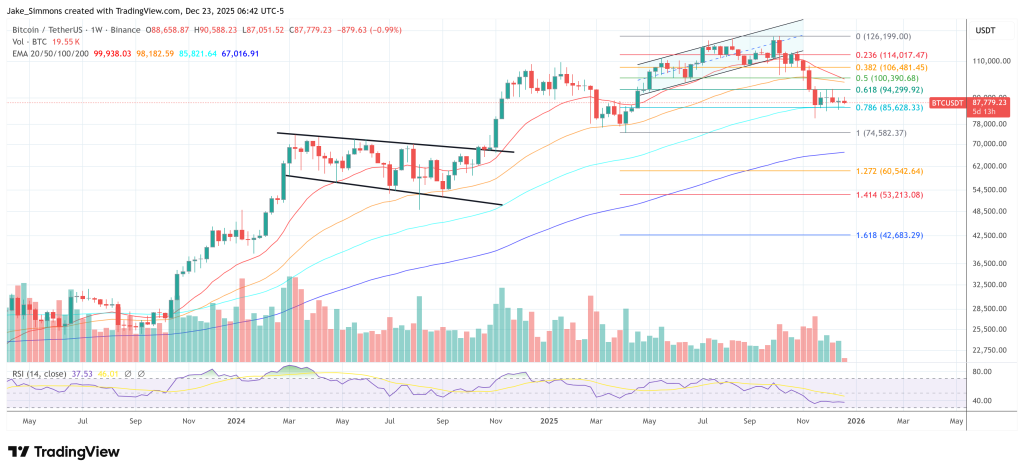
At press time, Bitcoin traded at $87,779.










 English (US)